
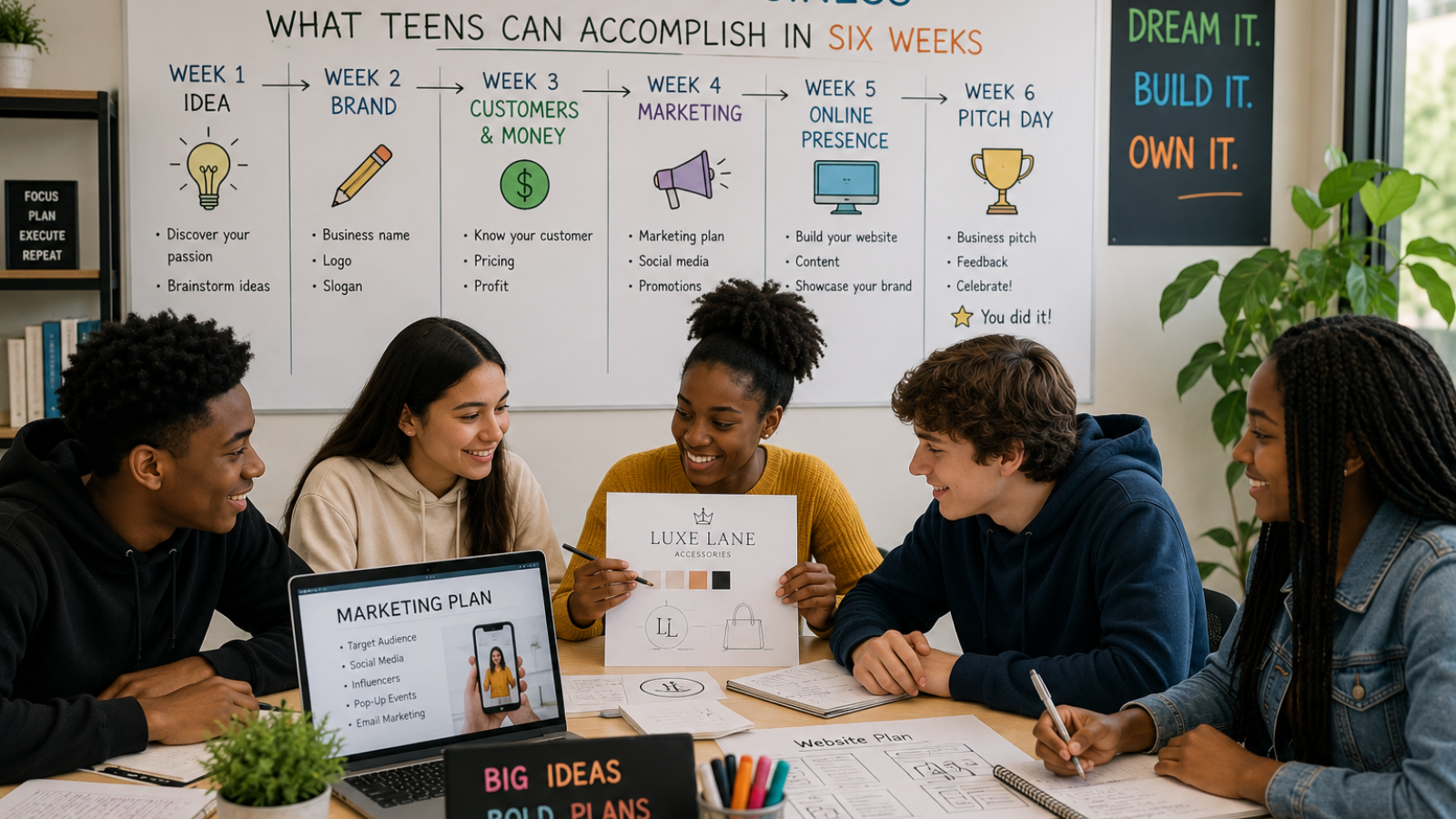
What could a young person accomplish with one business idea, the right guidance, and six Saturdays?
More than you might think.
A teenager can begin with a simple interest or idea and learn how to shape it into a business concept. Along the way, they can develop a brand, identify potential customers, understand pricing and profit, learn marketing strategies, build a website, and gain the confidence to present their idea to others.
At Strahan Venture Academy, our six-week youth entrepreneurship program is designed to introduce teens to the real-world process of building a business while developing skills they can use throughout their lives.
The program meets for two hours each Saturday for six weeks, giving students time to learn, practice, create, and build.
Here’s what that journey can look like.
Week 1: Discovering the Business Idea
Every business starts somewhere—with an idea.
During the first week, students explore their interests, talents, hobbies, and problems they might be able to solve.
A student might love baking, fashion, sports, technology, beauty, art, photography, gaming, crafts, or working with animals. Another student might already have a product or service in mind.
Students begin asking important questions:
What am I good at?
What do I enjoy doing?
What problem could my business solve?
Who might want to buy my product or service?
The goal is to help students understand that business ideas don’t have to begin with large amounts of money. Sometimes they begin with a skill, an interest, or simply noticing that something could be done better.
By the end of the session, students begin developing a business concept they can build upon throughout the program.
Week 2: Building a Brand
Once students have an idea, it’s time to give that idea an identity.
During Week 2, students learn about branding and why successful businesses need to be recognizable.
Students can begin developing elements such as their business name, logo, colors, slogan, and overall brand personality.
They also learn an important lesson:
A brand is more than a logo.
It’s the feeling customers associate with a business and the experience that business promises to provide.
This session gives students an opportunity to be creative while also learning to think strategically about how they want their businesses to be perceived.
Week 3: Customers, Pricing and Money
Having a great product or service doesn’t automatically create a successful business. Entrepreneurs must understand who their customers are and how their businesses will make money.
Students are introduced to concepts such as target customers, pricing, expenses, revenue and profit.
For example, if it costs $6 to make a product and the student sells it for $15, the entire $15 isn’t profit.
Understanding that difference is an important financial lesson.
Students begin thinking about questions such as:
Who is most likely to buy my product?
How much would that customer be willing to pay?
What will it cost me to provide my product or service?
How much profit could I earn?
These exercises make financial literacy practical because students apply the concepts directly to their own business ideas.
Week 4: Marketing and Getting Noticed
Even the best business needs customers.
During Week 4, students learn the basics of marketing and promotion.
They explore how businesses communicate with customers through websites, social media, flyers, advertisements, promotions, word-of-mouth, and other marketing methods.
Students also begin thinking about their business message.
Instead of simply saying, “Buy my product,” they learn to explain why someone should care about what they’re offering.
What makes the business different?
What problem does it solve?
Why would a customer choose it?
Learning how to answer those questions helps students become better marketers—and better communicators.
Week 5: Building an Online Presence
Today’s entrepreneurs need to understand technology.
That’s why digital skills are an important part of the Strahan Venture Academy experience.
Students are introduced to the role websites play in modern businesses and learn how entrepreneurs use an online presence to showcase products, explain services, build credibility, and connect with customers.
Students can begin developing a website for their business concept while learning how elements such as images, headlines, product information, navigation, and calls to action work together.
The goal is not simply to teach students how to use technology.
It’s to help them understand how to use technology as a business tool.
Instead of only consuming digital content, students begin learning how to create with technology.
Week 6: The Business Pitch
The final week brings everything together.
Students prepare to explain their business ideas through a business or elevator pitch.
They practice introducing themselves, describing their businesses, identifying their customers, explaining what makes their ideas unique, and communicating why someone should be interested.
For some students, standing in front of others and presenting may initially feel intimidating.
That’s exactly why the experience is valuable.
Public speaking, communication, and presentation skills can help young people far beyond entrepreneurship.
A student who learns how to confidently explain a business idea is also developing skills that can help with job interviews, college presentations, leadership opportunities, networking, and future careers.
Celebrating Completion
Completing six weeks of entrepreneurship education is an accomplishment worth recognizing.
Students who successfully complete the Strahan Venture Academy program receive a Certificate of Completion recognizing their participation and the skills they developed throughout the program.
The certificate represents more than attendance.
It represents six weeks of learning, creating, problem-solving, developing ideas, and stepping outside of their comfort zones.
For many students, it can be the beginning of a much larger entrepreneurial journey.
What Students Take With Them
At the end of six weeks, students may have developed a business concept, brand identity, customer profile, pricing strategy, marketing ideas, online presence, and business pitch.
But some of the most valuable outcomes aren’t things they can put in a folder.
They’re skills.
Confidence. Creativity. Communication. Financial awareness. Technology skills. Leadership. Problem-solving.
These skills are valuable whether a student eventually becomes an entrepreneur, attends college, enters the workforce, learns a trade, or pursues another path.
Six Saturdays Can Plant a Powerful Seed
Not every student who completes an entrepreneurship program will immediately start a company—and that’s not the expectation.
The bigger opportunity is exposure.
A young person who has never thought of themselves as an entrepreneur may suddenly realize:
“I could actually do this.”
A student who thought technology was only for entertainment may discover that it can be used to create something.
A quiet student may discover that they can confidently present an idea.
A creative student may begin seeing their talent as something valuable.
And a teenager with a simple idea may begin imagining a future they hadn’t considered before.
That’s the power of entrepreneurship education.
At Strahan Venture Academy, we want young people to understand that they don’t have to wait until adulthood to start developing the skills needed to build their futures.
Sometimes, it starts with an idea.
Sometimes, it starts with a Saturday.
And sometimes, six Saturdays can change the way a young person sees what’s possible.
Dream it. Build it. Own it.
Strahan Venture Academy — Developing the next generation of entrepreneurs, innovators, and leaders.
Add a Comment