

ChatGPT Image Sep 2, 2026, 05_56_49 PM

What Happens During a Strahan Venture Academy Saturday Class?

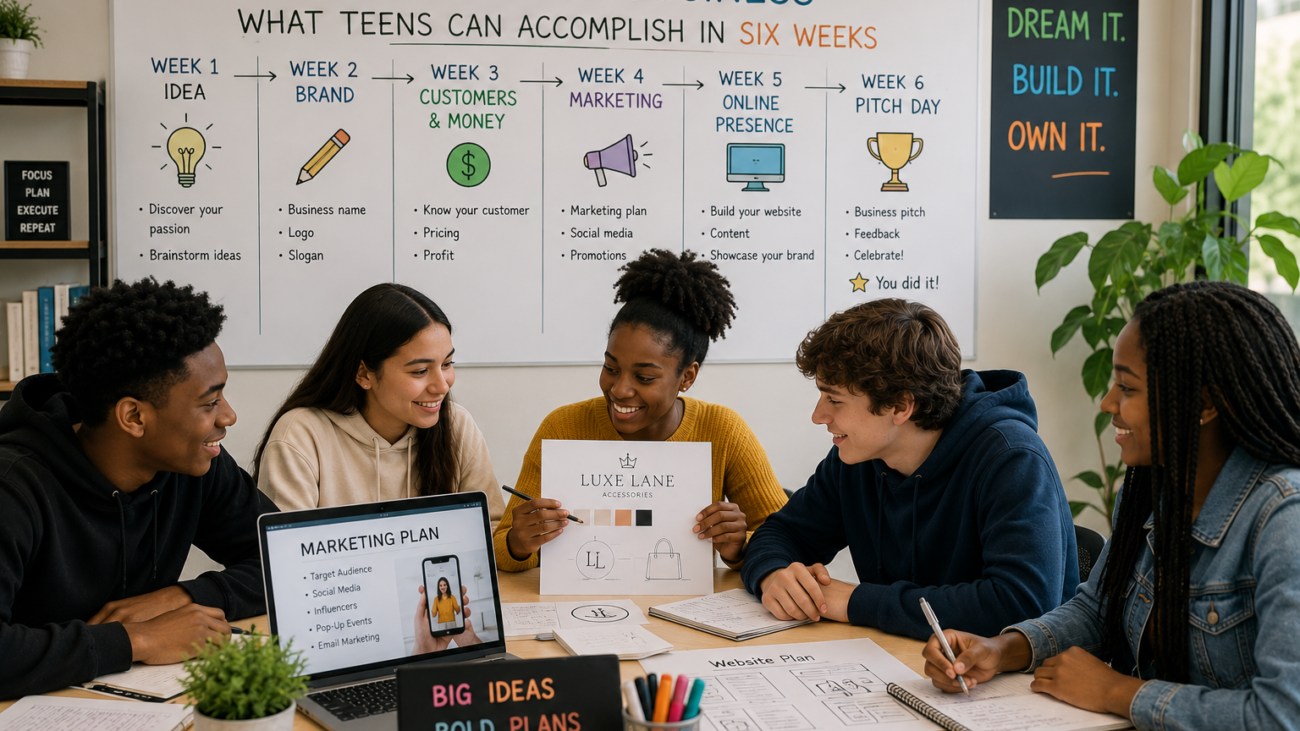
From Idea to Business: What Teens Can Accomplish in Six Weeks

What could a young person accomplish with one business idea, the right guidance, and six Saturdays?

More than you might think.

A teenager can begin with a simple interest or idea and learn how to shape it into a business concept. Along the way, they can develop a brand, identify potential customers, understand pricing and profit, learn marketing strategies, build a website, and gain the confidence to present their idea to others.

At Strahan Venture Academy, our six-week youth entrepreneurship program is designed to introduce teens to the real-world process of building a business while developing skills they can use throughout their lives.

The program meets for two hours each Saturday for six weeks, giving students time to learn, practice, create, and build.

Here’s what that journey can look like.

Week 1: Discovering the Business Idea

Every business starts somewhere—with an idea.

During the first week, students explore their interests, talents, hobbies, and problems they might be able to solve.

A student might love baking, fashion, sports, technology, beauty, art, photography, gaming, crafts, or working with animals. Another student might already have a product or service in mind.

Students begin asking important questions:

What am I good at?

What do I enjoy doing?

What problem could my business solve?

Who might want to buy my product or service?

The goal is to help students understand that business ideas don’t have to begin with large amounts of money. Sometimes they begin with a skill, an interest, or simply noticing that something could be done better.

By the end of the session, students begin developing a business concept they can build upon throughout the program.

Week 2: Building a Brand

Once students have an idea, it’s time to give that idea an identity.

During Week 2, students learn about branding and why successful businesses need to be recognizable.

Students can begin developing elements such as their business name, logo, colors, slogan, and overall brand personality.

They also learn an important lesson:

A brand is more than a logo.

It’s the feeling customers associate with a business and the experience that business promises to provide.

This session gives students an opportunity to be creative while also learning to think strategically about how they want their businesses to be perceived.

Week 3: Customers, Pricing and Money

Having a great product or service doesn’t automatically create a successful business. Entrepreneurs must understand who their customers are and how their businesses will make money.

Students are introduced to concepts such as target customers, pricing, expenses, revenue and profit.

For example, if it costs $6 to make a product and the student sells it for $15, the entire $15 isn’t profit.

Understanding that difference is an important financial lesson.

Students begin thinking about questions such as:

Who is most likely to buy my product?

How much would that customer be willing to pay?

What will it cost me to provide my product or service?

How much profit could I earn?

These exercises make financial literacy practical because students apply the concepts directly to their own business ideas.

Week 4: Marketing and Getting Noticed

Even the best business needs customers.

During Week 4, students learn the basics of marketing and promotion.

They explore how businesses communicate with customers through websites, social media, flyers, advertisements, promotions, word-of-mouth, and other marketing methods.

Students also begin thinking about their business message.

Instead of simply saying, “Buy my product,” they learn to explain why someone should care about what they’re offering.

What makes the business different?

What problem does it solve?

Why would a customer choose it?

Learning how to answer those questions helps students become better marketers—and better communicators.

Week 5: Building an Online Presence

Today’s entrepreneurs need to understand technology.

That’s why digital skills are an important part of the Strahan Venture Academy experience.

Students are introduced to the role websites play in modern businesses and learn how entrepreneurs use an online presence to showcase products, explain services, build credibility, and connect with customers.

Students can begin developing a website for their business concept while learning how elements such as images, headlines, product information, navigation, and calls to action work together.

The goal is not simply to teach students how to use technology.

It’s to help them understand how to use technology as a business tool.

Instead of only consuming digital content, students begin learning how to create with technology.

Week 6: The Business Pitch

The final week brings everything together.

Students prepare to explain their business ideas through a business or elevator pitch.

They practice introducing themselves, describing their businesses, identifying their customers, explaining what makes their ideas unique, and communicating why someone should be interested.

For some students, standing in front of others and presenting may initially feel intimidating.

That’s exactly why the experience is valuable.

Public speaking, communication, and presentation skills can help young people far beyond entrepreneurship.

A student who learns how to confidently explain a business idea is also developing skills that can help with job interviews, college presentations, leadership opportunities, networking, and future careers.

Celebrating Completion

Completing six weeks of entrepreneurship education is an accomplishment worth recognizing.

Students who successfully complete the Strahan Venture Academy program receive a Certificate of Completion recognizing their participation and the skills they developed throughout the program.

The certificate represents more than attendance.

It represents six weeks of learning, creating, problem-solving, developing ideas, and stepping outside of their comfort zones.

For many students, it can be the beginning of a much larger entrepreneurial journey.

What Students Take With Them

At the end of six weeks, students may have developed a business concept, brand identity, customer profile, pricing strategy, marketing ideas, online presence, and business pitch.

But some of the most valuable outcomes aren’t things they can put in a folder.

They’re skills.

Confidence. Creativity. Communication. Financial awareness. Technology skills. Leadership. Problem-solving.

These skills are valuable whether a student eventually becomes an entrepreneur, attends college, enters the workforce, learns a trade, or pursues another path.

Six Saturdays Can Plant a Powerful Seed

Not every student who completes an entrepreneurship program will immediately start a company—and that’s not the expectation.

The bigger opportunity is exposure.

A young person who has never thought of themselves as an entrepreneur may suddenly realize:

“I could actually do this.”

A student who thought technology was only for entertainment may discover that it can be used to create something.

A quiet student may discover that they can confidently present an idea.

A creative student may begin seeing their talent as something valuable.

And a teenager with a simple idea may begin imagining a future they hadn’t considered before.

That’s the power of entrepreneurship education.

At Strahan Venture Academy, we want young people to understand that they don’t have to wait until adulthood to start developing the skills needed to build their futures.

Sometimes, it starts with an idea.

Sometimes, it starts with a Saturday.

And sometimes, six Saturdays can change the way a young person sees what’s possible.

Dream it. Build it. Own it.

Strahan Venture Academy — Developing the next generation of entrepreneurs, innovators, and leaders.
ChatGPT Image Sep 2, 2026, 06_02_37 PM

How Entrepreneurship Education Builds Confidence in Young People

Confidence can change the direction of a young person’s life.

A confident young person is more likely to speak up, try something new, ask questions, share ideas, pursue opportunities, and recover when something doesn’t go as planned.

But confidence isn’t always something young people simply have. Often, it develops through experience.

That’s one of the reasons entrepreneurship education can be so powerful.

When young people are given an opportunity to create something of their own, make decisions, solve problems, work through challenges, and present their ideas, they begin discovering what they’re capable of accomplishing.

At Strahan Venture Academy, we believe entrepreneurship education isn’t only about teaching young people how businesses work. It’s also about helping them develop the confidence to believe their ideas have value.

Confidence Grows When Young People Have Ownership

In many traditional learning environments, students are told what assignment to complete, what subject to study, and what the correct answer should be.

Entrepreneurship is different.

Students have choices.

They can decide what type of business interests them. They can choose a business name, develop a brand, identify potential customers, think about pricing, create marketing ideas, and decide how they want to present their businesses.

Those decisions create a sense of ownership.

Instead of working on someone else’s idea, students begin saying:

“This is my idea.”

“This is my business.”

“This is something I created.”

That sense of ownership can be an important confidence builder.

Young People Discover That Their Ideas Matter

Sometimes young people hesitate to share their ideas because they’re worried about being wrong, being judged, or not being taken seriously.

Entrepreneurship gives them a different perspective.

An idea doesn’t have to be perfect to be worth exploring.

Students learn to ask questions such as:

What problem could I solve?

What could I create?

Who would need this?

How could I make my idea better?

As they develop answers, they begin seeing themselves as creators and problem-solvers rather than simply students completing an assignment.

A young person who realizes, “I came up with this idea myself,” begins developing confidence in their own thinking.

Small Accomplishments Create Bigger Confidence

Confidence rarely appears overnight.

It grows through small victories.

Choosing a business name is a victory.

Creating a logo is a victory.

Figuring out a price is a victory.

Building part of a website is a victory.

Completing a marketing project is a victory.

Standing in front of a group and explaining a business idea is a major victory.

Each accomplishment gives a student evidence that they can learn something new and complete something that may have seemed difficult at first.

Over time, those experiences begin changing the question from:

“Can I do this?”

to:

“How am I going to do this?”

That is an important shift.

Entrepreneurship Encourages Young People to Speak Up

Communication is an essential part of entrepreneurship.

Business owners must be able to explain what they do, talk with customers, answer questions, listen to feedback, and present their ideas.

For a young person who is naturally quiet or uncomfortable speaking in front of others, these activities can initially feel challenging.

But confidence develops through practice.

Students can start by explaining an idea to one person. Then they might discuss it with a small group. Eventually, they may be ready to present their business concept to an audience.

The goal isn’t to turn every student into the loudest person in the room.

The goal is to help young people become comfortable using their own voices.

Students Learn That Mistakes Aren’t the End

Fear of making mistakes can prevent young people from trying.

Entrepreneurship teaches an important lesson:

Things don’t always work the first time.

A business name might need to change.

A logo might need another design.

A product may cost too much to produce.

A website may not look right on the first attempt.

A presentation might need more practice.

Entrepreneurs adjust.

When students learn that they can make a mistake, correct it, and continue moving forward, mistakes become less frightening.

Instead of thinking, “I failed,” they can begin asking, “What can I change?”

That mindset builds resilience as well as confidence.

Technology Can Create Another Confidence Boost

Young people use technology every day, but there’s an important difference between using technology and creating with technology.

Imagine how a student feels when they see a website displaying a business name they created.

Or when they design marketing materials for their own idea.

Or when they realize they can use digital tools to promote a product or service.

Technology stops being something they simply consume.

It becomes something they can use to build.

That experience can be especially powerful for a young person who previously thought technology or business was too complicated for them.

Financial Knowledge Creates Confidence Too

Money can seem mysterious when young people aren’t taught how businesses actually earn it.

Entrepreneurship education can introduce students to practical concepts such as pricing, expenses, revenue, profit, budgeting, and startup costs.

Consider a student who creates a product that costs $5 to make and sells for $12.

Now there is a real reason to understand expenses and profit.

Financial concepts become connected to something the student created.

Understanding how money works can help young people feel more prepared to make financial decisions later in life.

Presenting a Business Idea Can Be a Defining Moment

One of the most powerful experiences in youth entrepreneurship education can happen near the end of a program.

The student stands up and presents.

Several weeks earlier, that student may have had nothing more than an idea—or perhaps no business idea at all.

Now they can explain their business name, product or service, target customer, pricing, marketing strategy, and what makes their idea special.

The presentation represents more than a business pitch.

It represents progress.

For a student who was nervous about speaking, completing that presentation can create a moment they’ll remember:

“I did it.”

Those three words can be incredibly powerful.

Confidence Extends Beyond Entrepreneurship

Not every student who studies entrepreneurship will become a business owner.

That’s okay.

The confidence they develop can follow them into many areas of life.

A student who learns to present a business idea may become more comfortable interviewing for a job.

A student who learns to create a website may become interested in technology.

A student who discovers a talent for branding may explore graphic design or marketing.

A student who learns about pricing and profit may become more interested in financial literacy.

A student who learns to lead a project may discover leadership abilities they didn’t know they had.

Entrepreneurship can open doors to interests, careers, and opportunities far beyond business ownership.

Creating Confident Young Leaders at Strahan Venture Academy

At Strahan Venture Academy, our goal is to create an environment where young people can learn by doing.

Throughout our six-week entrepreneurship program, students have opportunities to develop ideas, make decisions, solve problems, work with technology, learn business concepts, practice communication, and present what they’ve created.

Students who successfully complete the program also receive a Certificate of Completion recognizing their participation and achievement.

But the certificate is only one reminder of what they’ve accomplished.

The greater achievement may be the confidence they take with them.

We want students to leave understanding:

My ideas have value.

I can learn new skills.

I can solve problems.

I can speak for myself.

I can create something of my own.

I can build something I’m proud of.

Because when young people begin believing in their ability to create opportunities, they’re not simply learning entrepreneurship.

They’re beginning to see themselves differently.

And that confidence can last far beyond six Saturdays.

Dream it. Build it. Own it.

Strahan Venture Academy — Developing confident young entrepreneurs, innovators, and future leaders.

ChatGPT Image Sep 2, 2026, 06_06_44 PM

From Idea to Business: What Teens Can Accomplish in Six Weeks

What could a young person accomplish with one business idea, the right guidance, and six Saturdays?

More than you might think.

A teenager can begin with a simple interest or idea and learn how to shape it into a business concept. Along the way, they can develop a brand, identify potential customers, understand pricing and profit, learn marketing strategies, build a website, and gain the confidence to present their idea to others.

At Strahan Venture Academy, our six-week youth entrepreneurship program is designed to introduce teens to the real-world process of building a business while developing skills they can use throughout their lives.

The program meets for two hours each Saturday for six weeks, giving students time to learn, practice, create, and build.

Here’s what that journey can look like.

Week 1: Discovering the Business Idea

Every business starts somewhere—with an idea.

During the first week, students explore their interests, talents, hobbies, and problems they might be able to solve.

A student might love baking, fashion, sports, technology, beauty, art, photography, gaming, crafts, or working with animals. Another student might already have a product or service in mind.

Students begin asking important questions:

What am I good at?

What do I enjoy doing?

What problem could my business solve?

Who might want to buy my product or service?

The goal is to help students understand that business ideas don’t have to begin with large amounts of money. Sometimes they begin with a skill, an interest, or simply noticing that something could be done better.

By the end of the session, students begin developing a business concept they can build upon throughout the program.

Week 2: Building a Brand

Once students have an idea, it’s time to give that idea an identity.

During Week 2, students learn about branding and why successful businesses need to be recognizable.

Students can begin developing elements such as their business name, logo, colors, slogan, and overall brand personality.

They also learn an important lesson:

A brand is more than a logo.

It’s the feeling customers associate with a business and the experience that business promises to provide.

This session gives students an opportunity to be creative while also learning to think strategically about how they want their businesses to be perceived.

Week 3: Customers, Pricing and Money

Having a great product or service doesn’t automatically create a successful business. Entrepreneurs must understand who their customers are and how their businesses will make money.

Students are introduced to concepts such as target customers, pricing, expenses, revenue and profit.

For example, if it costs $6 to make a product and the student sells it for $15, the entire $15 isn’t profit.

Understanding that difference is an important financial lesson.

Students begin thinking about questions such as:

Who is most likely to buy my product?

How much would that customer be willing to pay?

What will it cost me to provide my product or service?

How much profit could I earn?

These exercises make financial literacy practical because students apply the concepts directly to their own business ideas.

Week 4: Marketing and Getting Noticed

Even the best business needs customers.

During Week 4, students learn the basics of marketing and promotion.

They explore how businesses communicate with customers through websites, social media, flyers, advertisements, promotions, word-of-mouth, and other marketing methods.

Students also begin thinking about their business message.

Instead of simply saying, “Buy my product,” they learn to explain why someone should care about what they’re offering.

What makes the business different?

What problem does it solve?

Why would a customer choose it?

Learning how to answer those questions helps students become better marketers—and better communicators.

Week 5: Building an Online Presence

Today’s entrepreneurs need to understand technology.

That’s why digital skills are an important part of the Strahan Venture Academy experience.

Students are introduced to the role websites play in modern businesses and learn how entrepreneurs use an online presence to showcase products, explain services, build credibility, and connect with customers.

Students can begin developing a website for their business concept while learning how elements such as images, headlines, product information, navigation, and calls to action work together.

The goal is not simply to teach students how to use technology.

It’s to help them understand how to use technology as a business tool.

Instead of only consuming digital content, students begin learning how to create with technology.

Week 6: The Business Pitch

The final week brings everything together.

Students prepare to explain their business ideas through a business or elevator pitch.

They practice introducing themselves, describing their businesses, identifying their customers, explaining what makes their ideas unique, and communicating why someone should be interested.

For some students, standing in front of others and presenting may initially feel intimidating.

That’s exactly why the experience is valuable.

Public speaking, communication, and presentation skills can help young people far beyond entrepreneurship.

A student who learns how to confidently explain a business idea is also developing skills that can help with job interviews, college presentations, leadership opportunities, networking, and future careers.

Celebrating Completion

Completing six weeks of entrepreneurship education is an accomplishment worth recognizing.

Students who successfully complete the Strahan Venture Academy program receive a Certificate of Completion recognizing their participation and the skills they developed throughout the program.

The certificate represents more than attendance.

It represents six weeks of learning, creating, problem-solving, developing ideas, and stepping outside of their comfort zones.

For many students, it can be the beginning of a much larger entrepreneurial journey.

What Students Take With Them

At the end of six weeks, students may have developed a business concept, brand identity, customer profile, pricing strategy, marketing ideas, online presence, and business pitch.

But some of the most valuable outcomes aren’t things they can put in a folder.

They’re skills.

Confidence. Creativity. Communication. Financial awareness. Technology skills. Leadership. Problem-solving.

These skills are valuable whether a student eventually becomes an entrepreneur, attends college, enters the workforce, learns a trade, or pursues another path.

Six Saturdays Can Plant a Powerful Seed

Not every student who completes an entrepreneurship program will immediately start a company—and that’s not the expectation.

The bigger opportunity is exposure.

A young person who has never thought of themselves as an entrepreneur may suddenly realize:

“I could actually do this.”

A student who thought technology was only for entertainment may discover that it can be used to create something.

A quiet student may discover that they can confidently present an idea.

A creative student may begin seeing their talent as something valuable.

And a teenager with a simple idea may begin imagining a future they hadn’t considered before.

That’s the power of entrepreneurship education.

At Strahan Venture Academy, we want young people to understand that they don’t have to wait until adulthood to start developing the skills needed to build their futures.

Sometimes, it starts with an idea.

Sometimes, it starts with a Saturday.

And sometimes, six Saturdays can change the way a young person sees what’s possible.

Dream it. Build it. Own it.

Strahan Venture Academy — Developing the next generation of entrepreneurs, innovators, and leaders.

ChatGPT Image Sep 2, 2026, 06_11_02 PM

Why Entrepreneurship Should Be Taught to Teens

Today’s teens are growing up in a world that is changing faster than ever. Technology is transforming the workplace, new businesses can be launched from a laptop, and young people have access to opportunities that previous generations could hardly imagine.

Yet many teens reach adulthood without ever learning how to turn an idea into something valuable.

Entrepreneurship education can help change that.

Teaching entrepreneurship to teens is about much more than teaching them how to start a business. It helps young people develop confidence, creativity, financial awareness, communication skills, leadership, and the ability to solve real-world problems.

Entrepreneurship Teaches Teens to Think Differently

Entrepreneurs learn to look at the world and ask questions.

What problem could I solve?

What could I create?

Who would benefit from my idea?

How could I make this better?

When teens begin thinking this way, they learn that they don’t always have to wait for opportunities to come to them. They can learn how to create opportunities of their own.

A teenager who enjoys baking might discover how that talent could become a small business. A student interested in technology might create a website or online service. Another young person might turn an interest in fashion, beauty, art, photography, gaming, sports, or crafts into a business idea.

The goal isn’t for every student to become a business owner. The goal is to help every student recognize possibilities.

It Builds Confidence

Many young people have great ideas but lack the confidence to share them.

Entrepreneurship gives teens opportunities to practice speaking, presenting, making decisions, working with others, and explaining their ideas.

Imagine a student starting a program unsure about speaking in front of others. Over time, that same student develops a business idea, creates a brand, learns about customers and eventually stands in front of a group and delivers a business pitch.

That experience can change the way a young person sees their own abilities.

Teens Need Financial Skills

Young people will eventually have to make important financial decisions, whether they become entrepreneurs or employees.

Entrepreneurship provides a practical way to introduce concepts such as:

  • Revenue and expenses
  • Pricing
  • Profit
  • Budgeting
  • Startup costs
  • Saving and reinvesting
  • Understanding the value of time and work

Instead of simply reading about these concepts, students can apply them to a business idea of their own.

For example, if a student wants to sell a product for $15, they need to understand how much it costs to make or purchase that product. They can then determine how much money is actually earned after expenses.

Suddenly, math and financial literacy have a real-world purpose.

Entrepreneurship Encourages Creativity and Problem-Solving

Businesses exist because someone identified a need, problem, or opportunity.

Teaching entrepreneurship encourages teens to become problem-solvers.

Rather than simply telling students what to do, entrepreneurship education challenges them to make decisions.

Who is my customer?

What should my business be called?

How much should I charge?

How will people find out about my product or service?

Why should someone buy from me instead of someone else?

There may not be one correct answer. Students have to research, think, experiment, make adjustments, and sometimes start again.

Those are valuable skills in business—and in life.

Technology Gives This Generation an Incredible Advantage

A young entrepreneur today has access to tools that once required significant money and resources.

Teens can learn to create websites, develop brands, design marketing materials, promote businesses online, communicate with customers, and sell products or services using digital technology.

This is one reason entrepreneurship and technology education work so well together.

Instead of teens being only consumers of technology, we can teach them how to use technology to create, build, market, and earn.

Entrepreneurship Develops Communication and Leadership

A great idea isn’t enough. Entrepreneurs must be able to communicate it.

Young people benefit from learning how to introduce themselves professionally, explain an idea clearly, listen to customers, work as part of a team, handle feedback, and speak confidently in front of others.

These abilities are valuable whether a student eventually owns a company, attends college, enters a trade, joins the workforce, or pursues another path.

Entrepreneurship education is therefore also career-readiness education.

Failure Becomes Part of Learning

One of the most important lessons entrepreneurship can teach young people is that an idea doesn’t always work perfectly the first time.

A product may need to change.

A price might be too high.

A marketing idea might not attract customers.

A presentation may not go as planned.

Instead of treating every mistake as a failure, students can learn to ask, “What did I learn, and what can I do differently next time?”

Developing that mindset at a young age can prepare students to handle challenges throughout their lives.

Young People Need Opportunities to Discover What They’re Capable Of

Sometimes a young person simply needs exposure.

A teen may never have considered becoming an entrepreneur because no one has introduced entrepreneurship as a possibility.

That’s why youth entrepreneurship programs matter.

They create an environment where young people can explore ideas, learn practical skills, ask questions, meet mentors, work with technology, and discover talents they may not have realized they possessed.

Our Approach at Strahan Venture Academy

At Strahan Venture Academy, we believe entrepreneurship should be experienced, not simply explained.

Our youth entrepreneurship program gives students an opportunity to move from an idea toward developing an actual business concept while learning practical skills they can continue using long after the program ends.

Students are introduced to areas such as business ideas, branding, customers, pricing, marketing, website development, communication, public speaking, and business pitching.

Throughout the program, students are encouraged to dream, create, problem-solve, and take ownership of their ideas.

Students who successfully complete the program also receive a Certificate of Completion, recognizing the work and skills they developed throughout their entrepreneurship journey.

Preparing Teens for More Than Business

We don’t know exactly what the workplace will look like 10 or 20 years from now.

But we do know that young people will need creativity, confidence, adaptability, financial knowledge, technological skills, communication abilities, and the courage to pursue opportunities.

Entrepreneurship education helps develop all of them.

When we teach a young person how to take an idea and begin building something from it, we’re teaching more than business.

We’re teaching them to believe that their ideas have value.

We’re teaching them that problems can become opportunities.

And most importantly, we’re helping them understand that their future is something they can help create.

Dream it. Build it. Own it.

Strahan Venture Academy — Empowering the next generation of entrepreneurs, innovators, and leaders.